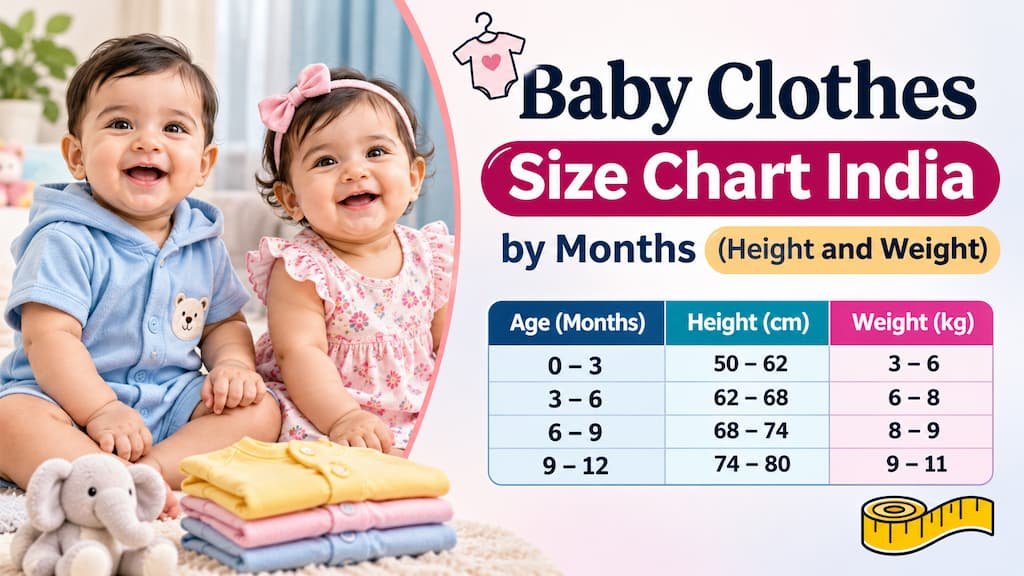
The average 3-month-old boy is 61.4 cm tall and weighs 6.4 kg, according to the WHO growth standards. The 0-3M size on Indian size charts ends anywhere from 58 to 64 cm.
Quick answer
Use this baby clothes size chart India parents can check against as a rough guide, and buy by your baby’s height and weight, not age. Four retailer charts put the top of 0-3M at 58 to 64 cm and 5.5 to 6.5 kg. The same label can differ by 6 cm between brands, so check the product page.
If your baby outgrew 0-3M clothes in two months, or you are about to order 6-9M and cannot tell whether it will fit, the age label is usually the problem, not your measuring. This guide shows where the labels fall short and how to choose a size that fits.
Baby clothes size chart India: by months, height and weight
The same size label covers different heights in different charts. At the top of 0-3M, four published charts, including Indian brands Luvlap, Menmoms and Miarcus, differ by 6 cm. The tables below set them beside WHO medians for the average baby at the end of each age band.
Height at the top of each size, in cm:
| Size label | Height cap across the four charts | Average boy at end of band | Average girl at end of band |
| NB (0 to 1 month) | 50-56 | 54.7 | 53.7 |
| 0-3M | 58-64 | 61.4 | 59.8 |
| 3-6M | 66-69 | 67.6 | 65.7 |
| 6-9M | 72-74 | 72.0 | 70.1 |
| 9-12M | 76-79 | 75.7 | 74.0 |
| 12-18M | 82-86.5 | 82.3 | 80.7 |
| 18-24M | 89-91.5 | 87.8 | 86.4 |
Weight at the top of each size, in kg:
| Size label | Lowest of the four charts | Highest of the four charts | Average boy at end of band | Average girl at end of band |
| NB (0 to 1 month) | 3.5 | 4.5 | 4.5 | 4.2 |
| 0-3M | 5.5 | 6.5 | 6.4 | 5.8 |
| 3-6M | 7.5 | 9.3 | 7.9 | 7.3 |
| 6-9M | 9 | 11.1 | 8.9 | 8.2 |
| 9-12M | 10.5 | 12.9 | 9.6 | 8.9 |
| 12-18M | 12 | 14.5 | 10.9 | 10.2 |
| 18-24M | 13.5 | 15.4 | 12.2 | 11.5 |
Each range runs from the lowest to the highest cap among Luvlap, Menmoms, Cuddle & Cradle and Miarcus. The chart-by-chart figures are listed under Sources and method. Cuddle & Cradle publishes inches and covers only the first 12 months, so its figures are converted and stop at 9-12M. Where a chart lists several rows under one label, the highest is used.
On the tightest chart (Luvlap), the average 3-month-old boy at 61.4 cm is past the 0-3M cap of 58 cm. On the roomiest (Menmoms), 0-3M runs to 64 cm and the same baby still fits. That gap is why some babies spend only weeks in newborn size and others far longer, and why a tag alone cannot tell you what fits.
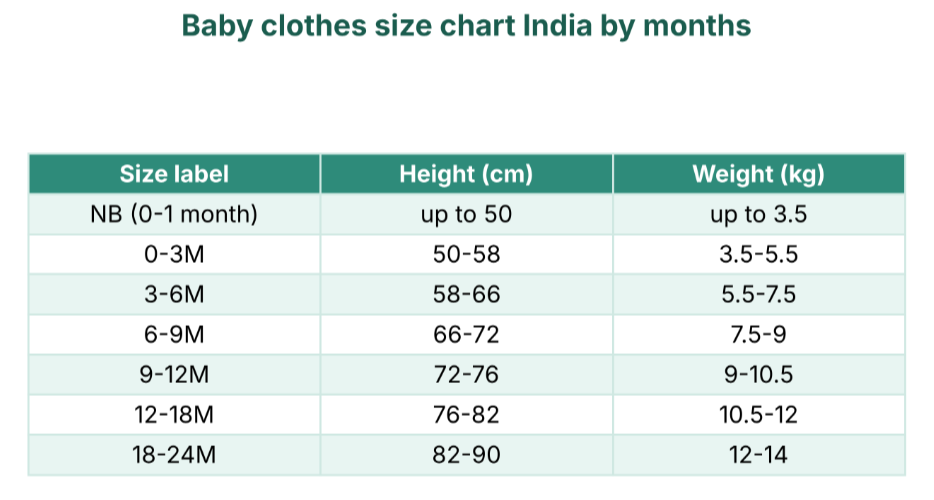
Baby clothes size chart India by months with height in cm and weight in kg.
Why baby clothes size labels and your baby often do not match
An age label is a guess about an average baby, and no retailer’s guess matches another’s. The charts above disagree by up to 6 cm at the same label. Menmoms says age-based labels vary widely across Indian baby clothing brands, and Miarcus says sizing can differ significantly. A 6-9M tag from one shop can fit like a 3-6M from another.
Birth size matters too. Luvlap suggests slightly larger sizes for a baby on the higher side of birth weight, and Cuddle & Cradle suggests the next size up for a baby at the top of a range.
How to measure your baby for clothes at home
Lay your baby on their back on a firm, flat surface. Gently straighten the legs and measure from the top of the head to the heel with a soft tape. A second person makes this much easier, because babies rarely stay still.
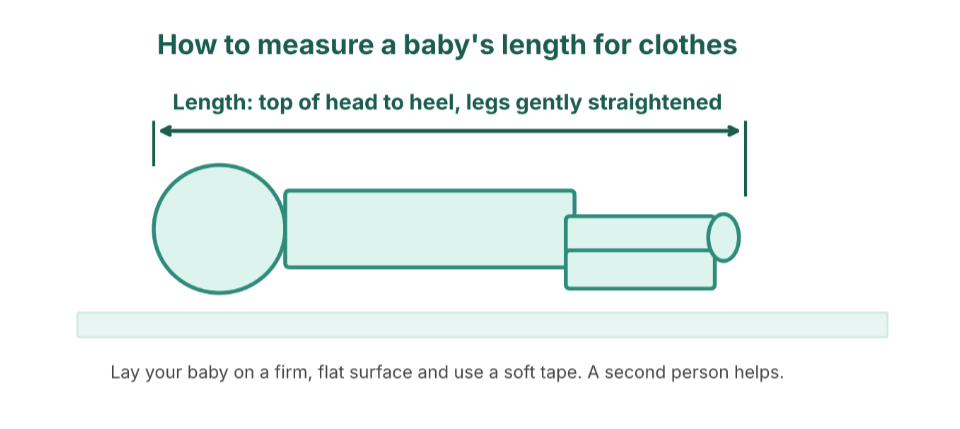
How to measure a baby’s length for the right baby clothes size.
For weight, use the numbers from your last clinic visit if it was recent, or a baby scale. For chest, wrap the tape around the fullest part, just under the armpits, and keep it snug enough to lie flat without pressing.
Then compare the numbers with the brand’s own chart on the product page. If height points to one size and weight to another, take the larger size. If your baby wears cloth nappies, measure again with the nappy on.
If you are unsure about your baby’s growth, ask your pediatrician. This content is for information only and is not medical advice.
Baby clothes size by month: what to expect
In the newborn size, expect a short stay. The average baby is 49.9 cm (boys) or 49.1 cm (girls) at birth, at or below the newborn cap of 50 to 56 cm depending on the chart. The arithmetic is blunt: WHO medians put a baby boy 11.5 cm longer at 3 months than at birth, close to 4 cm a month. A newborn-size outfit is short almost immediately, and a 0-3M outfit is short somewhere between about the 2-month and 4-month mark, depending on whether the chart caps it at 58 or 64 cm. Buy only a few pieces before delivery and keep the tags on until your baby is born. Size up straight away if the birth weight is high.
By 3 months the average boy is 61.4 cm, which is where 3-6M starts on all four charts. A large stack of 0-3M clothes can be outgrown early.
Between 6 and 9 months the label and the average baby line up. This is also when sitting and crawling change what you want from a cut: stretch at the waist, soft knees and no stiff seams across the tummy. We cover those details, including seasons and fabrics, in our guide to 6-9 month baby clothes.
From 9 months, growth in height slows a little and legs start to matter more as crawling turns into pulling up and walking. For 12 to 24 months, Luvlap recommends slightly roomy clothes, but not so loose that they cause tripping.
How fabric and garment type change the baby clothes size you need
Cuddle & Cradle notes that stretch cotton jersey is more forgiving than structured woven fabric. Rib knit and interlock knit stretch with the baby, so they tolerate a slightly snug fit. Woven cotton and muslin barely stretch, so a woven top or a kurta pyjama set needs the right length and chest, not just the right age. A loose cut such as a jabla forgives a size error better than a fitted bodysuit, which matches Cuddle & Cradle’s point that a loose romper is more forgiving than a fitted one. A bodysuit or romper has to fit from shoulder to crotch at once, so it forgives the least.
Nappies change the fit too. Cloth nappies and modern cloth diapers are usually bulkier than disposables. Menmoms notes that as diaper use increases, clothes may feel tight around the thighs and waist, so outfits with extra room at the bottom and two-piece sets suit heavier diaper phases. Cuddle & Cradle suggests checking the diaper area and torso length on bodysuits and rompers from 6-9 months. We found no published figure for how much extra room a cloth nappy needs, so measure your baby wearing the nappy you actually use, from shoulder to crotch, and compare it with the garment’s own measurements.
Check whether the cotton is pre-shrunk. Menmoms notes that cotton often shrinks after the first wash, which is a reason to take the slightly larger size, and pre-shrunk fabric is made to avoid this. If the label does not say pre-shrunk, leave room, and follow the care label when you wash. For the first months, choose tagless labels and flat seams so nothing scratches against newborn skin.
Baby clothes size for summer, winter and the festive season
Summer cottons from March to June should sit close to the body without pressing on it, so buy your baby’s measured size, not one up. Festive outfits from October to November, such as a kurta pyjama set or a frock suit, are often worn once or twice. Buy those in the current size, because an oversized festive outfit slides off the shoulder and looks wrong in photographs.
Winter is the one season for sizing up. Mild winter layering in South India usually needs only a light extra layer, so one size up on the outer piece is enough. Heavy fleece for North India and the hills needs more room for what goes underneath, so size up the fleece only and keep the inner layers in your baby’s usual size. Cuddle & Cradle also notes that allowing room is practical for winter clothes bought weeks ahead.
When to size up baby clothes
Menmoms and Luvlap both suggest buying one size ahead in the first year because babies grow fast, and both put measurements ahead of age. Menmoms adds that when you are between two sizes, the bigger one usually feels more comfortable. One size up is enough. Cuddle & Cradle warns that oversized clothes restrict movement, and two sizes up leaves sleeves over the hands and legs that trip a crawling baby.
Winter can justify a slightly larger size, because layers need room. Menmoms notes that cotton often shrinks after the first wash, so wash and measure one piece before you commit to buying many in the same size. For help deciding how many pieces you need in each size, see the wardrobe section of our kids clothes buying guide.
Baby clothes sizing mistakes to avoid
1. Choosing by age alone. The age on the tag describes an average baby, not yours.
2. Overbuying newborn and 0-3M sizes. Cuddle & Cradle suggests only a couple of newborn outfits and a few in 0-3M, and the arithmetic above shows why.
3. Going two sizes up. A garment that is too big is harder to move in and less comfortable than one that is slightly snug.
4. Ignoring torso length on one-piece outfits. A romper or jumpsuit that is long enough for the legs but short in the body pulls at the shoulders. Our baby jumpsuit guide goes through what to check.
5. Measuring without the nappy your baby wears. Cloth nappies and modern cloth diapers add bulk at the hips and rise, so measure with the one you use.
6. Trusting one brand’s chart for every brand. Read the size guide on each product page.
What to do this week
Measure your baby’s length and weight tonight and compare both numbers with the size chart on the product page you plan to order from. If they point to different sizes, buy the larger one. Keep this baby clothes size chart India table open while you shop.
Sources
We compared the height and weight caps of four published baby clothing charts, then set them beside WHO median length and weight at 1, 3, 6, 9, 12, 18 and 24 months. Figures were checked on November 1, 2026. Medians are the 50th percentile for boys and girls.
- WHO weight-for-age, boys
- WHO weight-for-age, girls
- WHO length-for-age, boys
- WHO length-for-age, girls
We could not open size charts from FirstCry, Mothercare India or H&M India, so they are not included. These charts are general references, and your baby’s brand may differ.
Height cap by chart, in cm:
| Size label | Luvlap | Menmoms | Cuddle & Cradle | Miarcus |
| NB (0 to 1 month) | 50 | 56 | 56 | 54.5 |
| 0-3M | 58 | 64 | 61 | 61 |
| 3-6M | 66 | 69 | 67 | 68.5 |
| 6-9M | 72 | 74 | 72 | 73.5 |
| 9-12M | 76 | 79 | 77.5 | 79 |
| 12-18M | 82 | 84 | none | 86.5 |
| 18-24M | 90 | 89 | none | 91.5 |
FAQs:
No, and the label is usually the reason. The average 3-month-old boy is 61.4 cm and 6.4 kg, and the average girl is 59.8 cm and 5.8 kg. The 0-3M size tops out at 58 cm on some charts and 64 cm on others. Move to 3-6M and measure again in a month.
Buy very little before delivery. The newborn size tops out between 50 and 56 cm depending on the chart, and the average baby is 49.9 cm (boy) or 49.1 cm (girl) at birth, so many babies move up within weeks. Keep the tags on, and buy the rest after your baby is born and measured.
Trust the chart on that brand’s product page over any general chart, including this one. Four published charts disagree by up to 6 cm at the same label, so no general chart fits every brand. Compare your baby’s measured length and weight with that brand’s ranges, and ask the seller if the tag and the page disagree.
Take the larger size. Height and weight do not always point to the same size, and the larger one is easier to live with. Height tells you whether sleeves and legs will reach, and weight tells you about girth. A cuff can be rolled up, but a garment that is too small cannot be fixed.
A bulky nappy often makes clothes feel tight at the thighs and waist, so this is a fair worry. Choose two-piece sets or loose cuts, take the larger size for rompers and bodysuits, and measure your baby with the nappy on. Check each garment’s own measurements, because no chart gives a standard allowance.
One size up is enough for most babies. Cuddle & Cradle warns that oversized clothes restrict movement, and Luvlap advises slightly roomy but not loose clothes from 12 to 24 months. Two sizes up leaves sleeves over the hands and trouser legs that can catch a crawling baby.
One number is not a verdict. The figures here are WHO medians, so half of healthy babies sit below them. If your baby is gaining slowly or your pediatrician has raised a concern, follow their advice. For clothes, go by the measurements you took, not by age.