
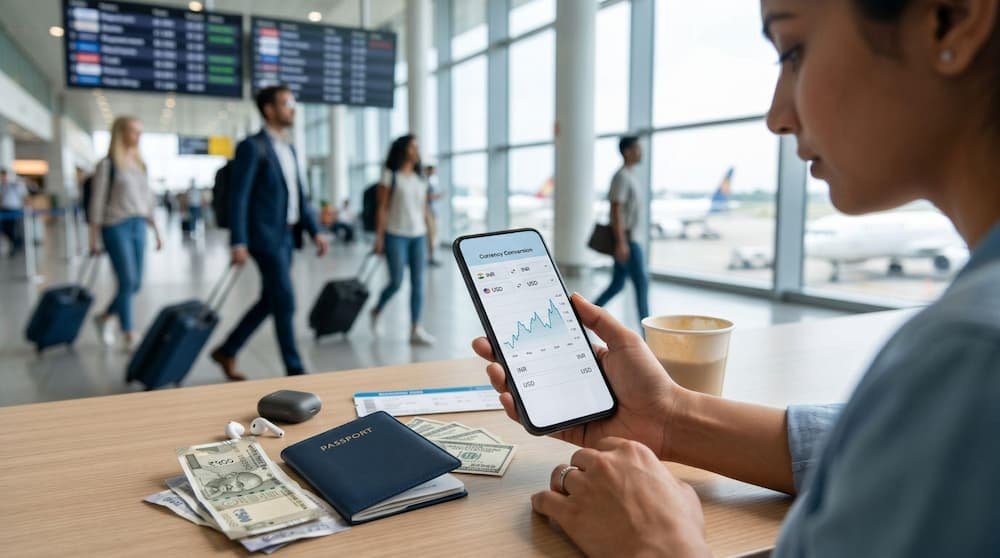
If you have ever checked foreign exchange rates before an international trip, you may have noticed that the numbers keep changing almost every day. One day, the US Dollar may cost ₹90 (dynamic), while the next day it could rise to ₹85 or fall slightly lower.
This constant movement is known as currency fluctuation or currency rate fluctuation. While the changes may seem small initially, they can directly impact your international travel budget, especially when you are exchanging large amounts of money.
Understanding how the currency exchange rate works can help travellers make smarter financial decisions before travelling abroad. Whether you are planning a holiday, studying overseas, or travelling for work, even minor exchange rate changes can influence how much you spend overall.
What is a currency exchange rate?
A currency exchange rate is the value of one country’s currency compared to another.
For example:
- 1 US Dollar (USD) = ₹90
- 1 Euro (EUR) = ₹96
- 1 British Pound (GBP) = ₹112
This means you need ₹90 to buy 1 US Dollar, ₹96 to buy 1 Euro, and so on.
Since global financial markets operate continuously, these rates keep changing throughout the day based on demand and supply.
What is currency fluctuation?
Currency fluctuation refers to the rise or fall in the value of one currency against another.
For Indian travellers, this usually means:
- The Indian Rupee is becoming stronger or weaker compared to foreign currencies
- Changes in how much foreign currency you receive for your money
For example:
- If the Rupee weakens against the Dollar, you will need more INR to buy the same amount of USD
- If the Rupee strengthens, you can buy more USD for less INR
This daily movement is called currency rate fluctuation.
Why do currency rates fluctuate daily?
There are several reasons why currency exchange rates change regularly. These fluctuations are influenced by both global and domestic economic conditions.
Demand and supply in the forex market
Currencies work like any other asset in the market. Their value changes based on demand and supply.
For example:
- If global demand for US Dollars increases, the Dollar strengthens
- If demand for Indian Rupees decreases, the Rupee weakens
International trade, tourism, investments, and imports all affect currency demand.
Inflation rates
Countries with lower inflation often have stronger currencies because their purchasing power remains stable.
If inflation rises significantly in a country, its currency may weaken against others. This is one reason why inflation trends affect currency exchange rate movements globally.
Interest rates
Central banks adjust interest rates to manage inflation and economic growth. Higher interest rates may attract foreign investments, increasing demand for that country’s currency.
For example:
- If US interest rates rise, investors may move money into US markets
- This can increase demand for USD and strengthen the Dollar globally
Political and global events
Political instability, elections, wars, international conflicts, or global economic uncertainty can create sudden currency fluctuations.
Investors often move towards stable currencies during uncertain periods, causing sharp exchange rate movements.
Events such as:
- Global recessions
- Oil price shocks
- International conflicts
- Trade restrictions
can impact currency markets quickly.
International trade and imports
Countries that import more than they export often face pressure on their currency value.
India imports large quantities of:
- Crude oil
- Electronics
- Gold
When import costs rise, demand for foreign currencies increases, which can weaken the Indian Rupee.
How currency fluctuation impacts your travel budget
Many travellers underestimate how much currency rate fluctuation can affect international travel expenses.
Even a small change in exchange rates can increase your overall trip cost.
Your hotel and flight expenses may increase
If the Indian Rupee weakens before your trip:
- International hotel bookings become more expensive
- Flight costs may increase
- Visa and insurance expenses may rise
For example: A hotel costing USD 2,000:
- At ₹84/USD = ₹1,68,000
- At ₹87/USD = ₹1,74,000
That small exchange rate movement increases your expense by ₹6,000.
Daily travel spending becomes costlier
A weaker Rupee affects:
- Dining abroad
- Shopping
- Local transport
- Attraction tickets
- International payments
Travellers may end up spending much more than originally planned.
International card payments become expensive
Many banks add forex markup charges on top of the base currency exchange rate.
This means travellers pay:
- Currency conversion costs
- Forex markup fees
- International transaction charges
Traditional bank cards may charge 3% to 5% additional forex markup, increasing overseas spending costs further.
Budget planning becomes difficult
Constant currency fluctuation makes it harder to estimate accurate travel expenses.
Travellers who delay currency exchange until the last minute may face:
- Poor exchange rates
- Higher travel budgets
- Reduced spending flexibility abroad
How can travellers manage currency fluctuation better?
While exchange rates cannot be controlled, travellers can take steps to reduce the impact of currency fluctuation.
Monitor exchange rates in advance
Tracking currency exchange rate trends before your trip can help you exchange money when rates are relatively favourable.
Many travellers monitor forex markets for a few weeks before converting large amounts.
Avoid last-minute currency exchange
Airport forex counters usually provide poor rates and higher service fees.
Planning your foreign currency exchange early gives you:
- Better rates
- More provider options
- Reduced panic decisions
Use zero forex markup cards
International cards with zero forex markup can help reduce hidden international transaction costs.
Traditional bank cards often add extra charges over the live exchange rate, increasing your overseas expenses.
Split your forex purchases
Instead of exchanging all your money at once, some travellers convert smaller amounts gradually to reduce the impact of sudden rate swings. This approach can help average out currency rate fluctuation over time.
Choose transparent forex providers
Many forex providers advertise attractive rates but include hidden fees later.
Always check:
- Final conversion value
- Service charges
- Delivery fees
- GST
- Forex markup
Transparent pricing is essential when buying foreign currency.
How Niyo helps travellers manage forex costs
Niyo is built for Indian travellers who want full control over what they spend abroad, without paying extra for it.
Here’s what you get:
- Zero forex markup on all international transactions
- Foreign Currency exchange with doorstep delivery in select cities
- Buyback guarantee on unused foreign currency
- Real-time exchange rate tracking
- International VISA debit and credit cards
No hidden conversion charges. No surprises on your statement. Just live VISA exchange rates, every time you pay abroad.
Way forward
Currency fluctuation is a natural part of the global economy, and exchange rates can change daily based on multiple financial and geopolitical factors.
For international travellers, these fluctuations directly impact:
- Travel budgets
- Hotel costs
- Overseas spending
- International transactions
- Foreign Currency purchases
Understanding how currency exchange rate movements work helps travellers plan better and avoid unnecessary expenses.
By monitoring rates early, avoiding hidden forex charges, and choosing transparent forex solutions, travellers can manage their international expenses more effectively and travel with greater financial confidence.