
Baby winter clothes in India work best as layers: a 3 to 6 month baby needs one more layer than the adult holding them, which means a cotton bodysuit, a warm top and bottom, and an outer layer only when you step outside. That is the plus-one rule from the American Academy of Pediatrics (AAP), and it changes once the baby is asleep.
Picture it: 6 a.m. in January, fog on the windows. Delhi’s lowest minimum last January was 2.3°C, recorded at Palam on 15 January, according to the India Meteorological Department. A relative hands you a woollen topi, two sweaters and a shawl, and your baby will certainly be warm. Possibly too warm. This guide sorts baby winter clothes by layer, then splits the day from the night, because the right outfit at 6 a.m. is the wrong one at 2 a.m.
Quick answer: For baby winter clothes in India, dress a 3 to 6 month baby in a cotton bodysuit, a warm top and bottom, and one outer layer for outdoors, which is one more layer than you are wearing. Add a cap, socks and mittens outside. At night, use a sleepsuit or wearable blanket instead, and keep the razai, kambal and loose quilts out of the cot.
Baby winter clothes India: the three-layer system
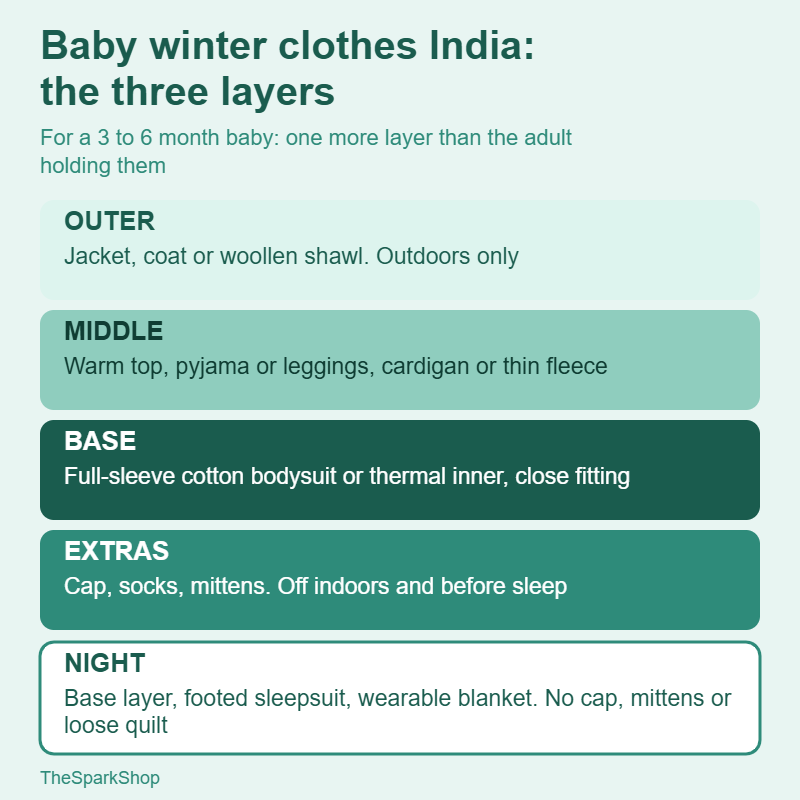
Several thin layers keep a baby warmer and drier than one thick garment. The AAP says several thin layers keep infants dry and warm, topped with a hat, mittens and warm boots. For a 3 to 6 month baby, that works out as follows.
| Layer | What goes here | When it comes off |
|---|---|---|
| Base | Full-sleeve cotton bodysuit or thermal inner, close fitting | Not during the day. Change it if it gets damp |
| Middle | Warm top with pyjama or leggings, plus a cardigan or thin fleece | When the chest feels hot or you move to a warm room |
| Outer | Jacket, coat or woollen shawl for going out | The moment you are indoors or buckled into a car |
| Extras | Cap or topi covering the ears, socks or booties, mittens | Indoors, and always before sleep |
The AAP’s own example for a cold-weather outing starts with close-fitting layers such as long-sleeved bodysuits, then a sweater or thermal-knit top, then a thin fleece jacket. Wet clothes are a risk too: the AAP names damp clothing as one of the common causes of hypothermia in children, so a baby who has spit up or leaked through a nappy needs a dry base layer, not another sweater on top.
Is your baby not 3 to 6 months old? The same three layers suit a 0 to 3 or 6 to 12 month baby outside the first 42 days, with only the sizes changing. The AAP’s safe sleep recommendations cover babies up to 1 year, so the night rules below apply to them too.
Baby winter clothes India at night: sleepsuits and wearable blankets
Daytime clothing is warmth you can adjust. Night clothing is warmth that cannot end up over the baby’s face.
The AAP says blankets, quilts, pillows, sheepskins and other loose bedding should be kept out of an infant’s sleeping environment because, although they are warm, they are linked to suffocation deaths. It recommends one-piece sleepers or wearable blankets instead. In a North Indian home, loose bedding usually means the razai, kambal, quilt or shawl that goes over a sleeping child.
A night outfit for a 3 to 6 month baby:
- A long-sleeve cotton bodysuit or thermal inner as the base.
- A footed sleepsuit or a pyjama set over it.
- A wearable blanket (sleep sack) over the top, if the room is cold.
- No cap, no mittens, no loose shawl.
The cap and mittens come off because overheating can increase the risk of SIDS, and the AAP’s 2022 update, reported by ABC News, advises that infants should not wear hats indoors, with an exception for the first hours of life. The same AAP guide says your baby only needs one more layer than you would wear in the same environment. If the room is cold, that leaves a warmer sleepsuit or a heavier wearable blanket as the options, not a loose cover.
Bed sharing, TOG ratings and cold floors
If your family shares a bed, the AAP does not recommend bed sharing with your baby under any circumstances. A razai or quilt shared with an adult is the specific risk, because loose bedding is what the AAP keeps out of an infant’s sleep space. As ABC News reported, the AAP advises babies to sleep in the same room as their parents for at least six months, but on a separate, firm, flat surface.
Two limits of the layer table. Wearable blankets come in different weights, often labelled with a TOG rating for warmth. I could not find an AAP or Indian guideline that matches TOG to room temperature, so I am not giving a chart: start with the lighter sack and use the chest check. On cold tile or marble floors, my advice is a mat under floor play and socks or a footed sleepsuit.
This guide covers clothing only. The rest of safe sleep, such as placing the baby on their back for every nap and night, is in the AAP’s safe sleep guide. For any questions about your own baby, ask your paediatrician.
Baby winter clothes India by time of day and city
The rule is the same in every city: one layer above the adult. What changes is what the adult is wearing, so use yourself as the thermometer. The table shows how that plays out over a North Indian winter day, with the adult column as an illustration.
| Time and place | What an adult would wear | Baby outfit |
|---|---|---|
| 6 to 9 a.m., fog, outdoors | Sweater and jacket or shawl | Base, middle and outer layers, cap, socks, mittens |
| Midday, sun, outdoors | One sweater, or none | Base and middle layers. Take the outer layer off first |
| Midday, indoors, no heater | A light sweater | Base and middle layers, socks |
| Evening, outdoors | Sweater and jacket | Base, middle and outer layers, cap |
| Bedtime | Pyjamas and a razai | Base layer, sleepsuit, wearable blanket. No cap, mittens or loose cover |
I have not set temperature cut-offs, because I could not find an official Indian guideline that gives baby clothing by degrees. The adult-plus-one rule scales instead. In a hill town the adult wears a heavy jacket, so the baby gets thicker versions of the same three layers. In a mild South Indian winter the adult wears a light cardigan, so the baby gets a cotton bodysuit and one thin layer over it.
How to check a baby is warm enough in winter
Do not guess from how the room feels to you. Check the baby. The AAP lists these signs of overheating: sweating, a hot chest or flushed skin. So the check is simple: put your hand on the baby’s chest. If it is hot or damp, take off one layer.
Repeat the check after the baby has been indoors for about 15 minutes, because the outfit that was right in the fog is often too much in a closed room. That interval is my own, not a guideline.
One limit on this guide: it is written for a 3 to 6 month baby. For the first 42 days, the Government of India’s Home Based Newborn Care programme has ASHA workers measure the baby’s temperature and advise skin-to-skin contact and a warmer room if it is below 97°F. If your baby is that young, follow your ASHA worker’s or doctor’s advice instead of the layer table above.
For newborns, the Indian Academy of Pediatrics (IAP) issued 2022 Standard Treatment Guidelines on neonatal hypothermia, as reported by Medical Dialogues. I could not find an IAP page on overheating or infant sleep clothing, so the layering and sleep rules here follow the AAP.
Baby winter safety: heaters, angithi and closed rooms
A study of fatal carbon monoxide (CO) cases at AIIMS Delhi, published in the Journal of Family Medicine and Primary Care in 2024, covered 56 deaths. It found that 95% occurred in winter and that the most common sources were coal burned in earthen or iron vessels to heat rooms, and structural fires. The authors say installing CO detectors is crucial.
CO is colourless and odourless, so a room can feel fine while the air is not. PTI reported one case in Bihar’s Chhapra where four members of a family, including three infants, died of suspected CO poisoning after a charcoal brazier was lit in a closed room.
For a baby’s room, my recommendation is simple:
- Keep the angithi or sigri out of the baby’s room entirely, not just out of reach.
- Never sleep with any burning fuel in a closed room. An expert quoted by Siasat advises keeping a window or door slightly open for cross ventilation with any heater, angithi or coil.
- Put the warmth in the baby’s clothing, not the air. That is the point of the layers above.
Baby winter clothes India: fabrics, jackets and car seats
My advice on fabric: put cotton next to the skin, with wool or fleece over it, and read the care label before the first wash. A woollen cardigan or a thin fleece jacket works as the middle layer, which matches the AAP’s example of a sweater or thermal-knit top with a thin fleece jacket over it. I am not making claims about eczema, allergies or sensitive skin here. If your baby has a skin condition, your paediatrician is the right person to ask.
If your baby travels in a car seat, bulky jackets need a separate warning. The AAP says that bulky clothing, including winter coats and snowsuits, should not be worn under a car seat harness. In a crash, the fluffy padding flattens and leaves extra space under the harness, and a child can slip through the straps. If you use a car seat, the AAP’s alternatives are:
- Dress the baby in thin layers instead of one thick one.
- Buckle the baby in first, then put a blanket or the coat, worn backwards, over the harness straps.
- Warm the car before you leave, and keep the infant seat indoors until then so it is not cold when the baby goes in.
- Check the fit: University of Utah Health says that if you can pinch the harness straps, they need to be tightened.
If your baby travels in an auto or cab, or in your arms, skip this part. The layer rules above still apply, and the outer layer should come off once you are indoors.
Baby winter clothes India: what to buy for a 3 to 6 month baby
Here is a minimum winter wardrobe. These quantities are my suggested starting point, not a sourced standard. They assume daily washing and slow drying in fog and low sun, which is why there are enough pieces to rotate.
| Item | Suggested quantity | Note |
|---|---|---|
| Full-sleeve cotton bodysuits or thermal inners | 5 | Close fitting, true to size |
| Warm tops and pyjamas or leggings | 3 sets | Slightly roomy so they fit over the base layer |
| Cardigans or thin fleece jackets | 2 | One in the wash, one in use |
| Footed sleepsuits | 3 | For nights |
| Wearable blankets (sleep sacks) | 2 | Match the weight to the room |
| Outer jacket or coat | 1 | Outdoors only |
| Caps, socks or booties, mittens | 2 caps, 4 pairs of socks, 2 pairs of mittens | Off indoors and before sleep |
Size the base layer true to size and the middle layers slightly up, so a warm top still fits over a bodysuit. To pick a size by months and height, check the baby clothes size chart India before you order, because brand charts differ by several centimetres. If your baby is closer to 6 to 9 months, the 6 to 9 months baby clothes guide covers that age in more detail, and the kids clothes buying guide covers the wider wardrobe.
Common baby winter clothes India mistakes
- Using one outfit for day and night. A fog-morning outfit with cap and mittens is too much for sleep, where overheating raises the SIDS risk.
- Covering a sleeping baby with a razai, kambal or shawl. The AAP keeps all loose bedding out of the infant’s sleep space.
- Leaving the cap and mittens on indoors, especially at bedtime.
- Burning an angithi or sigri in a closed room, or in the baby’s room at all.
- Wearing a puffy jacket under a car seat harness.
Baby winter clothes India FAQs
Dressing and sleep questions
One more than the adult with them. Outdoors that usually means a cotton bodysuit, a warm top and bottom, and a jacket or shawl, plus a cap, socks and mittens. Indoors, take off the outer layer and the extras. Check the baby’s chest: sweating, a hot chest or flushed skin means remove a layer.
The AAP says blankets, quilts and other loose bedding should stay out of an infant’s sleep space because they are linked to suffocation deaths. Use a footed sleepsuit or a wearable blanket instead. Adults can keep their razai or kambal, as long as it never goes in the cot.
No. The AAP warns that overheating can increase the risk of SIDS and advises against hats indoors, apart from the first hours of life. Take the cap and mittens off before sleep and rely on the sleepsuit and wearable blanket. For a baby under 42 days, follow your ASHA worker’s or doctor’s advice.
Heater and car seat questions
No. Burning coal or charcoal in a closed room can build up carbon monoxide, which is colourless and odourless. A study of fatal CO cases at AIIMS Delhi found 95% happened in winter. Keep the angithi out of the baby’s room, and if you use any heater, keep a window or door slightly open.
Not under the harness. The AAP says bulky clothing, including winter coats and snowsuits, should not be worn under a car seat harness, because the padding flattens in a crash and leaves slack. Dress the baby in thin layers, buckle in, then lay a blanket or a backwards coat over the straps.
What to do this week
Tonight, take the razai, kambal and any loose shawl out of the cot, and put your baby in a footed sleepsuit with a wearable blanket instead. Tomorrow at 6 a.m., dress your baby in the base and middle layers, add the outer layer, cap and socks for the fog, and put your hand on the baby’s chest after 15 minutes indoors. If an angithi is part of your winter routine, move it out of the baby’s room today. For more guides on baby and kids clothing, see TheSparkShop.
Sources
The layering and sleep advice here follows the AAP, a US body. Ask your paediatrician about your own baby.
- AAP, Cold weather safety
- AAP, Winter car seat safety tips
- AAP, A parent’s guide to safe sleep
- Mayo Clinic, Bulky winter wear and car seat safety
- Journal of Family Medicine and Primary Care, fatal CO poisoning at AIIMS Delhi (2024)
- NHM Assam, Home Based Newborn Care leaflet
- Ministry of Health and Family Welfare, HBNC posters
- India Meteorological Department, Delhi monthly weather report, January 2026
- ABC News, AAP 2022 safe sleep update on hats
- University of Utah Health, 3 steps to bundle your baby
- PTI via DT Next, Chhapra CO deaths
- Siasat, angithi smoke deaths in Delhi
- Medical Dialogues, IAP Standard Treatment Guidelines 2022 on neonatal hypothermia
Disclaimer
This content is for information only and is not medical advice. Ask your paediatrician about your own baby.
Article written by TheSparkShop Editorial Team.


Pingback: Thespark shop boy & girl clothes online: Affordable Kids Fashion